NASA’s Voyager 1 Reaches One Light-Day from Earth
NASA’s Voyager 1 Reaches One Light-Day from Earth
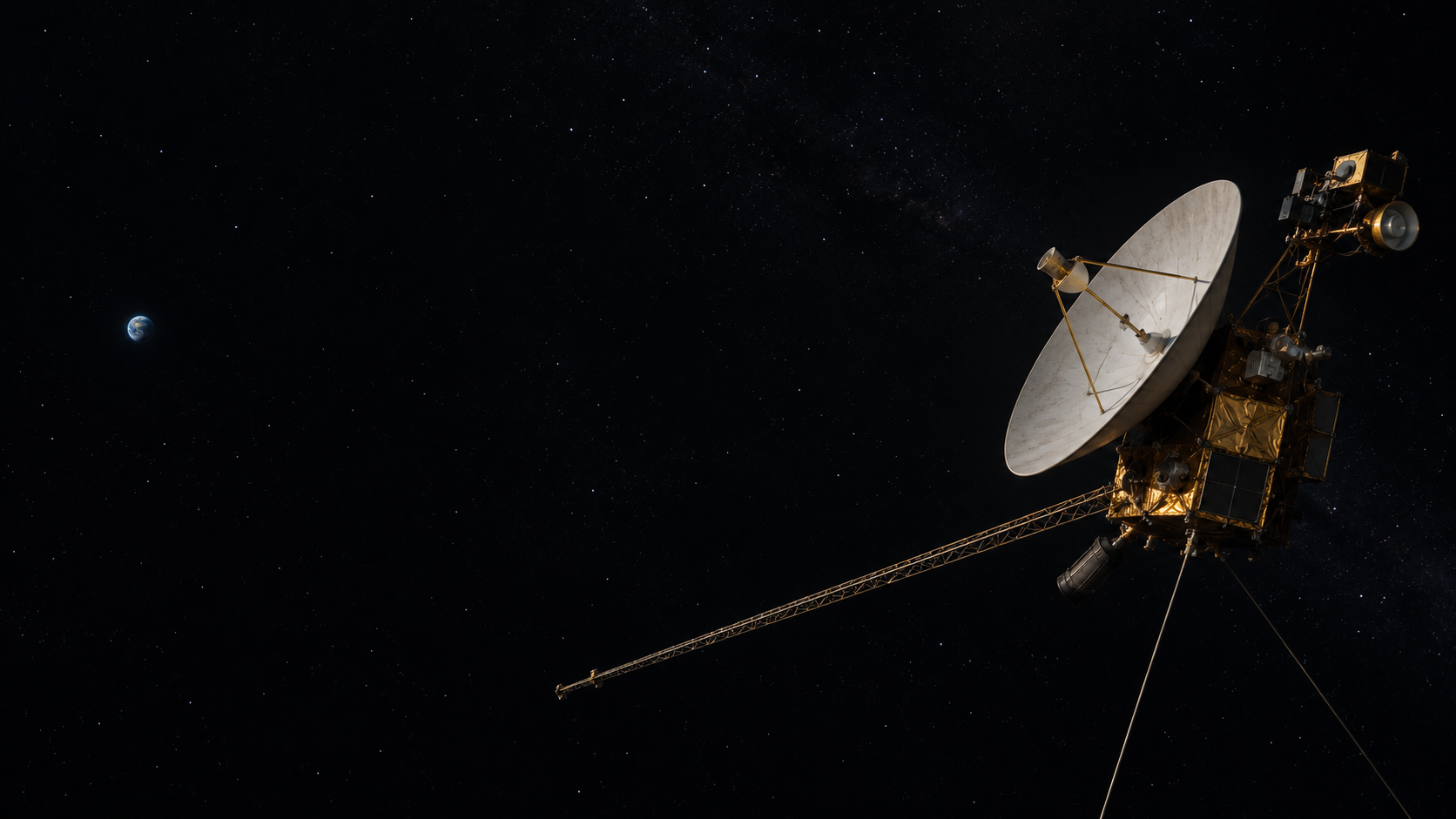
Voyager 1 has reportedly reached approximately one light-day from Earth after nearly five decades in space. The milestone highlights the extraordinary range of NASA’s longest-running deep-space mission and reinforces Voyager 1’s status as the farthest human-made object from Earth.
A light-day is a distance, not a measure of travel time. It is the distance light travels through a vacuum in 24 hours—about 25.9 billion kilometers or 16.1 billion miles. At that distance, a radio signal takes roughly one day to travel between Earth and Voyager 1, creating a theoretical round-trip delay of about two days.
What One Light-Day Means
The term can be confusing because it includes the word “day.” A light-day is a unit of distance based on the speed of light, not the amount of time Voyager 1 needed to travel. The exact distance from Earth changes continuously as both Earth and the spacecraft move.
One light-day is approximately 173 times the average Earth–Sun distance, known as one astronomical unit. It is also far greater than the distance between Earth and the Moon, which light crosses in about 1.3 seconds.
The milestone does not mean Voyager 1 has traveled one light-year, reached another star, or approached another planetary system. A light-year is about 365 times farther than a light-day.
Voyager 1’s Journey
NASA launched Voyager 1 in 1977 to study the outer planets. The spacecraft made detailed observations of Jupiter and Saturn, including their atmospheres, rings, magnetic environments, and moons.
Voyager 1 reached its distant trajectory through planetary gravity assists. By passing near Jupiter and Saturn, it used their motion and gravitational fields to change its path and increase its velocity relative to the Sun. This technique allowed the spacecraft to travel outward without using rocket engines continuously.
The mission was not originally designed solely as an interstellar spacecraft. Its continued operation became possible because its systems survived far beyond their planned planetary mission, supported by careful power management, software updates, and increasingly selective use of its instruments.
Voyager 1 later crossed the heliopause, the boundary where the solar wind gives way to the interstellar medium. Beyond that boundary, it measures conditions in interstellar space. This region lies between stars, but Voyager 1 remains extremely far from any other stellar system.
Why the Milestone Matters
Voyager 1’s distance is both an engineering record and a scientific achievement. The spacecraft provides direct measurements from a region that no Earth-based instrument can physically occupy. Its observations include data about interstellar plasma, magnetic fields, cosmic rays, and the interaction between the heliosphere and its galactic surroundings.
The mission has also tested the limits of long-term engineering. Its radioisotope power supply continues to weaken, its electronics have aged, and its signal has become increasingly faint. NASA has switched off nonessential systems and must continually decide which instruments, heaters, transmitters, and support functions can remain active.
Voyager 1’s computers were built in the 1970s, and replacement hardware is unavailable. Engineers must diagnose problems remotely and develop solutions that fit the spacecraft’s original architecture. Software patches, revised operating procedures, and power-management changes can take days to evaluate because of the communication delay.
Communicating with Voyager 1
NASA communicates with Voyager 1 through the Deep Space Network, which uses large ground antennas to send commands and receive data from distant spacecraft.
At a one-light-day distance, communication cannot occur in real time. A command takes approximately one day to arrive, and confirmation or diagnostic data can take another day to return. Engineers must plan carefully and account for antenna alignment, background noise, spacecraft orientation, Earth’s motion, and the spacecraft’s changing position.
The signal also becomes weaker as it spreads across space. Voyager 1 transmits with far less power than modern terrestrial communication systems, making every exchange technically demanding.
What Voyager 1 Is Doing Now
Voyager 1 continues moving away from the solar system through interstellar space. Its physical journey will continue even after its instruments stop operating or communication with Earth ends.
As available power declines, NASA must prioritize the scientific functions that provide the greatest value. Even limited measurements can improve scientists’ understanding of the interstellar environment and the boundary between the solar system and the space between stars.
The exact end of communications depends on the condition of the spacecraft’s systems and NASA’s operating decisions. When contact eventually ends, Voyager 1 will continue traveling through the Milky Way without active guidance or communication.
Voyager 1 Compared with Other Spacecraft
Voyager 1 and Voyager 2 both launched in 1977 and explored the outer planets. Voyager 1 visited Jupiter and Saturn, while Voyager 2 conducted the only close flybys of Uranus and Neptune. Their trajectories differ, making Voyager 1 the more distant of the two spacecraft.
New Horizons, which performed the first close flyby of Pluto, is another important outer-solar-system mission. However, “farthest spacecraft” and “most recent outer-solar-system mission” describe different categories. Distance alone does not determine scientific value.
Voyager 1’s importance comes from its discoveries at the outer planets, its direct measurements beyond the heliopause, and its exceptional operating life—not simply from how far it has traveled.
Common Misunderstandings
Voyager 1 Has Not Traveled One Light-Year
A light-year is the distance light travels in one year. It is approximately 365 times farther than a light-day. Voyager 1 remains relatively close to the solar system on the scale of interstellar distances.
Voyager 1 Is Not Traveling at the Speed of Light
The term “light-day” describes distance, not speed. Voyager 1 travels at roughly 17 kilometers per second relative to the Sun, depending on the reference frame. Its enormous distance results from nearly five decades of continuous motion and planetary gravity assists.
Interstellar Space Is Not Another Star System
Entering interstellar space means passing beyond the heliosphere into the region between stars. It does not mean Voyager 1 has reached another star or planetary system.
Conclusion
Voyager 1’s reported one-light-day distance illustrates the scale of deep space and the durability of a spacecraft launched in 1977. The probe has not reached another star, traveled one light-year, or approached the speed of light. It has accumulated its distance through decades of motion, gravity assists, and careful mission operations.
Voyager 1 remains a moving scientific instrument, a challenging communications partner, and a lasting record of human exploration. As its power declines, its data and engineering legacy will continue to shape research into the heliosphere, interstellar space, and long-duration spaceflight.
Frequently Asked Questions
How far away is Voyager 1 from Earth?
The reported milestone places Voyager 1 approximately one light-day from Earth, or about 25.9 billion kilometers (16.1 billion miles). The exact distance changes continuously.
What is a light-day?
A light-day is the distance light travels in 24 hours. It is a unit of distance, not time. A radio signal would take approximately one day to travel that distance.
Is Voyager 1 still in the solar system?
Voyager 1 has entered interstellar space beyond the heliopause. The definition of the solar system varies depending on whether it refers to the planetary region, the heliosphere, or the Sun’s broader gravitational influence.
Is Voyager 1 still communicating with NASA?
NASA continues attempting to communicate with Voyager 1 through the Deep Space Network. Its weak signal, aging hardware, limited power, and roughly one-day one-way delay make operations increasingly difficult.
How fast is Voyager 1 traveling?
Voyager 1 travels at roughly 17 kilometers per second relative to the Sun, depending on the reference frame. That is far below the speed of light.
Will Voyager 1 reach another star?
Voyager 1 is not headed toward a nearby star on a practical human timescale. It will continue drifting through interstellar space after communication ends.
Related Articles
-
 Supermoon 2025: What to See and When to Watch
-
 Southern California’s Role in the Lunar Economy
-
 How a Giant Star Swallowed Its Companion and Exploded
-
 Voyager 1 Is One Light-Day From Earth: What It Means
-
 BepiColombo’s Eight-Year Journey to Mercury
-
 Could Known Particle Physics Explain Dark Energy?
-
 Nearby Triple-Star System That “Shouldn’t Exist” Explained
-
 How Science Can Prevent a Biological Apocalypse
-
 Voyager 1 Reaches One-Light-Day Milestone
-
 Welopōʻai: A Triple-Star System 28 Light-Years Away
-
 Star Eating Its Companion: What the Images Reveal
-
 Potatoes Grown in Simulated Moon Soil: Why It Matters
-
 BepiColombo’s Mercury Orbit Insertion Explained
-
 Leonid Meteor Shower 2026: How to Watch the Peak
-
 How Failed Supernovae May Create Black Holes
-
 Gravity Messaging: What the Elevator Experiment Shows